Search This Blog

Wednesday, August 20, 2014

Know When To Hold’em, Know When To Fold’em

After a long absense, our gaming group was finally able to get together for a game. The real world sucks sometimes (like we’re actually required to attend jobs to make money, which is dumb), that’s why we escape to a fantasy one. So we were all excited to be entering our one-shot verse again and leaving our troubles behind. Except that’s not how things worked out.

By the time we were an hour and a half into our game, our DM was ready to murder us all. We players had decided to be petulant. All of us were tired from the week and taking a nap on the floor was sounding like a really nice option. And much like 2-year olds, we expressed this through immaturity and temper tantrums. So in this hour and a half we insulted some people in a tavern, poisoned each other, had a stand off with the good guys (we’re an evil party, remember), burned down another tavern, attempted to extort money from the tavern owner in exchange for saving him from said burning tavern, stole all of this tavern owner’s valuables, and then once again fought amongst ourselves.

It didn’t help that our party was made up of a female Drow assassin (who somehow ended up being the group leader and spokesperson), Zugg the half-Orc Fighter, a falsely philosophical Dragonborn Monk, and a samurai with a lot of swords and truly questionable morals.

It was about dinner time, so our DM declared it time for a break. He needed a reprieve from our in-fighting and really scary decision making processes, and a trip to the game store and a local fast food joint would be a perfect distraction. About an hour (and some ibuprofen) later, we reconvened.

The game improved from there. Energy was low for a while after our dinner break, but by the time our samurai got a hold of the time travel artifact and went back in time to change his back story in order to save his master who had been murdered, we were all invested once again. The DM was able to handle our antics and we finished the adventure on a high note, ready for the next game.

The moral of this story? Sometimes, you need to step away from a game in order to reinvest yourself in its success. This could mean taking a 5-minute water break, an hour dinner, or even putting the game off to another day. If you feel that you can’t enjoy playing because you’re tired, or unfocused, or you developed a headache because your Drow just suggested letting a bunch of people die in a fire because they couldn’t pay her to save them, call a time out. It will be more enjoyable for you and for all of your fellow players if you can bring your best to the game table.

Baby DM out.

Friday, August 15, 2014

The Duel

“You killed my sister!” Arissa Embers called out.
“She touched my stuff,” Carolina Braxwell responded.
Then all hell broke loose in Nine Mead Hall. Crossbow bolts were answered by bolts of fire and a final bolt of lightning from Arissa Embers brought Carolina to the ground with a smoking hole in her chest.
“This is for my sister,” Arissa said as she knelt down to finish Carolina off. But Carolina rolled a nat 20. Twice.

Lords, ladies, and variations thereupon I must apologize for our recent lack of content. The reasoning is good. Or at least moderately not bad. Life happened. Specifically teenagers. Teenagers that need me to teach them history. So I’ve been out of commission for a bit. I come back to you now at the turn of the tides, on this Friday when I feel I’ve had enough sleep.

Combat in tabletop roleplaying games is the main draw for many players. Zugg, for example, doesn’t really pay attention unless he’s fighting something, about to fight something, or making attempts to pick a fight with something. It’s amusing but can sometimes detract from the tension or drama in a roleplaying scenario. Still, having him regularly fist bump orcs hard enough to sever their wrists is worth all the times he has ruined or destroyed my plans.

I like running combat, especially in DnD Next. I feel I’m pretty darn good at it largely because my players and I care more about combat feeling and sounding epic than if it strictly follows the rules. In many instances combat might only function for one round before roleplaying gets in the way. This is why a Samurai and a Warforged Cowboy can have a philosophical stare-off down a tavern hallway while a Drow Poisoner waits to make her move and Sarven Sylmaris fish-flops his way over a balcony into the waiting arms of an orc below. Sure the Warforged shot at Sarven and the Poisoner is about to hit the whole second story with a Darkness spell but for a moment everyone’s poised and thinking about how cool their next move will be.

My favorite use of combat, though, is the duel. I will admit that I’ve watched the fight between Inigo Montoya and the Man in Black more times than I can count (at least a hundred) and my favorite instance of written combat is the duel between Oberyn Martell and the Mountain in Storm of Swords. I love duels for their tension and their drama and their awesome vocal exchanges. In a tabletop setting a duel can be the perfect cut away during a moment of roleplaying or the epic conclusion to a night of tavern based debauchery.

I try to create villains that my characters hate or have pissed off enough to create the kind of situation that would necessitate a duel. With my recent group I’ve hit 3 out of 4 (though technically Zugg’s was with a shark and he duels things all the time). What follows are my helpful hints for creating duels and running them:

  • Establish the stakes of the duel at the start. Is it to the death? Are there healers nearby who will intervene? Are there healers nearby who won’t intervene? Is anyone betting on the outcome? Are the combatants evenly matched? Having your low health sorcerer duel a barbarian at the end of the day when the magic-user has burned through all of their spells but one lone burning hands is certainly a tense moment but it isn’t exactly a fair fight. If you want your players to care about a duel then it needs to be one that they could possibly win but they could also easily lose.

  • Make sure it’s a show. The duel between Inigo and Westley is done in a remote location but the audience sees it and can enjoy its energy. In a tabletop setting a player should be in the right setting for a duel with the right atmosphere. A misty mountainside with two armies starring one another down is a good place to start. The entertainment stage of an inn isn’t bad at all. The deck of a pirate ship evokes the right kind of swashbuckling feeling. Even a duel fought in an open field can be intense if done right. Two skilled swordspersons starring one another down across a field of grain before charging and meeting blades is kind of cool to think about.

  • It’s ok if the other players are just the audience. Unless you’re running the duel for the person who is always the star of your games. Exercise caution when starting a duel with a player but if the other characters are passive observers that’s ok. Duels should have audiences and sometimes a conflict doesn’t need the interference of the whole party, particularly if it’s an emotional or dramatic confrontation.

  • If a player wants to intervene then you need to be careful. Hopefully your party is already working well together but sometimes a player has to be a hero and try to save the day. Approach situations like this with tact. You should know your players well enough to know whether the interference of a party member will be welcomed or met with fury.

  • Make it more about roleplaying then about dice rolls. This is more about personal preference but I will always yield in the face of good roleplaying. Even if I’m rolling 17+ on everything. Any effort a player makes to create a situation that is memorable and grand is going to be rewarded in the course of the duel. Of course, I as the DM am going to do everything in my power to have the villains do the same thing.

Arissa lifted Carolina’s head up and made to finish her. In that moment Carolina twisted lithely, tripping her foe. Arissa hit the stage face-up just as Carolina brought down a vial of acid right into her open eyes.

“Say hi to your sister for me, bitch,” Carolina smirked over Arissa’s screams and finished her with a smooth slash of steel.

Monday, July 28, 2014

System Spotlight: Star Wars

A Long Time Ago in a Galaxy Far, Far Away …

I may be a humble teacher, dungeonmaster, blog-author, sword sorcerer but sometimes I feel like I have a strong understanding of how people think. When I was young one trilogy of movies forever changed the way I looked at the world, stories, conflict, and the spiritual questions that plague mankind. I’m not talking about Indiana Jones but you were close. Lord of the Rings wouldn’t change me profoundly until I was a teenager. I’m of course talking about Star Wars.

From my style of writing, sense of humor, and general sense of self-importance you can potentially see the lasting influence Han Solo has had on my psyche. I can’t be alone, though. Who never wanted to strap a blaster on their hip and fly a starship from port to port, smuggling goods for the next big score and understanding an incomprehensible walking carpet? Also Luke was there, I guess. And Leia was really badass too …

I’m getting off topic. There are cool Star Wars RPGs. Check em out!


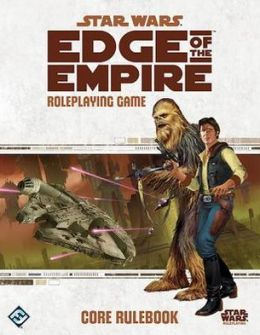
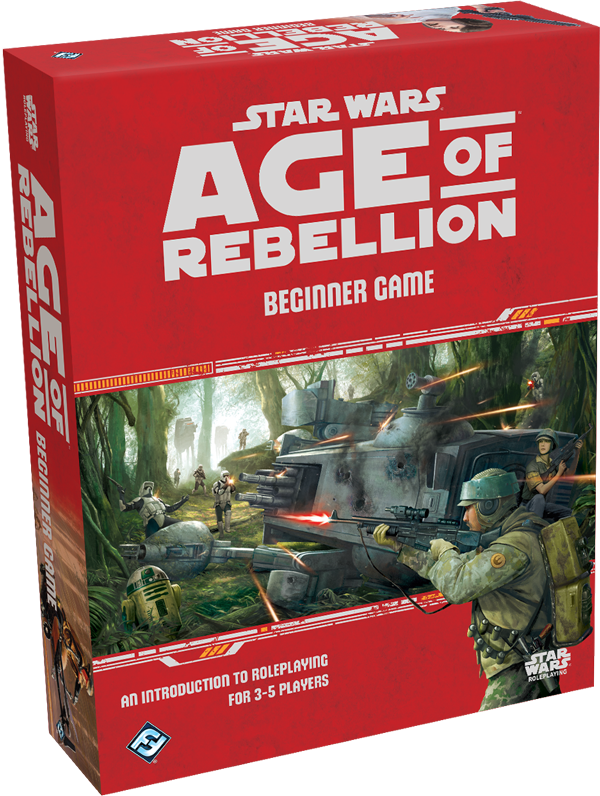
Star Wars Edge of the Empire and Star Wars Age of Rebellion utilize identical systems of character creation and dice use but have entirely different themes and tones. I recently purchased the Age of Rebellion Beginner Box pictured less than an inch above these words. I’ve been flipping through the Edge of Empire rulebook for the past few weeks. Here are my thoughts:

Age of Rebellion is for those persons who want to fight against the Empire. You want to be a rebellion commando or pilot or infiltrator who locates Imperial strongholds and blows them up in the name of galactic freedom. Admirable goals, in my opinion.

Edge of the Empire is all about being a scoundrel. The party is supposed to be a fringe criminal element operating on the outer rim, dodging bounty hunters, blackmail, Imperial patrols, and dwindling supplies to try and catch a break. It’s Firefly in the Star Wars Universe. I drooled a little as I typed that sentence.

The dice pool requires purchasing their unique dice or by utilizing a very complex chart to convert D6s, D8s, and D12s into the necessary symbols. I’m going to give you the short, short version of how these dice work:

  • There are Good dice and Bad dice
  • If you are good at things you get more Good dice
  • If you are trying to accomplish something hard or there’s a time limit you have to roll more Bad dice
  • You have to have more Successes show up on all the dice rolled than Failures
  • Even if you Succeed you may do it in a bad way thanks to secondary symbols and vice versa. You can Fail in a spectacular way.
  • There are also Criticals and Anti-Criticals

I just saved you about 45 minutes of deciphering. You’re welcome.

Both games have classes, sub-classes, and races like any good Tabletop Roleplaying Game. There are equipment charts all over these books, statistics blocks for starships, ideas for what sort of debts your scoundrels might need to pay off eventually, etc.

Here’s what separates Star Wars from your average Tabletop experience. It’s bursting with cool droids (playable), intense ship battles (think asteroid field dogfights, escape runs while trying to get the Hyperdrive to work, intense jaunts through narrow canyons while turbolasers blow dust and sand up onto the sensors), and more planets than you can swing a wookiee at (author’s note: wookiees are more likely to swing you). We’re not talking just Tatooine and Coruscant like you’re sick of. You want to go to Corellia, birthplace of the one and only Han Solo? Read up about it and make it happen. You want to go to Klak’dor VII, home planet of the buttheaded cantina band? I won’t judge. Hoth? Cool place. Cloud City? It’s a cut above the rest. I could sit here and make Star Wars planet puns for a long time and my editor would kill me if I did that.

There are some interesting rules for being a Force Sensitive Exile, as well, but I have to admit I’m not 100% on them. But how could you not want to be something called a Force Sensitive Exile while you’re bouncing from starbase to starbase on your rickety ship and exchanging blaster fire with mercenary lizard people?! Seriously?! WHO DOESN’T WANT THAT?!!!

I want to leave you with one final thought about how incredible I find this Star Wars RPG. Its design accomplishes one of my new favorite things about the Tabletop experience: freedom. You can run a narrow and rigid campaign that forces your players to hunt down a renegade smuggler who stole your previous ship and all the sweet spice you had on it. Or you can bounce from planet to planet, hoping for work and barely scraping by as you outrun the hired guns of a Hutt you crossed three planets ago while you were freeing a Twi’lek Dancer from his prison because she knew the access codes for a shipping crate packed with Corusca Gems. I literally came up with that as I was writing it because STAR WARS.

Monday, July 21, 2014

System Spotlight: Shadowrun

My Rules & Riddles compatriot had a few things to get off of his chest last week, so we took a break from our scheduled programming to bring you “Bards are the worst, and also not fun, and also we hate them.” But if you will remember, our original topic for the coming weeks was setting.


Some really bad people don’t like medieval fantasy. They don’t dream of hanging out in a tavern in a fantasy world and being a badass elf sorcerer warlord. I personally don’t understand these communists people, but we don’t want to leave them out of the nirvana that is tabletop gaming. So allow me to introduce Shadowrun.

http://media.aintitcool.com/media/uploads/shadowrun1.jpg

Shadowrun has a little bit of everything. Magic, medieval weaponry, robots, and guns all coexist somewhat peacefully in a futuristic parallel-Earth type setting. Megacorporations hold just as much, if not more, power than governments. Humans have undergone rapid mutation, creating variant races such as elves, dwarves, orks, and gnomes. Still other humans have been infected with an advanced virus that has turned them completely into dangerous, non-sentient beasts. If you’re playing a game by the default scenario, the players are Shadowrunners. Shadowrunners are free agents that complete tasks for corporations, the government, or various crime organizations so that they cannot be traced back to the source. So think hacking, espionage, and assassination.

Yes, it is just as awesome as it sounds. If you have never searched the web (I favor Pinterest for my RPG inspiration) for cyberpunk or cybergoth, prepare to be enthralled. Shadowrun has a gritty, urban feel augmented by the super technology that exists throughout this future world. Your character can have cybernetic enhancements. You can carefully plan out covert missions, or strap a laser-katana to your back and go wreak havoc through the city. I just… I can’t even...

CYBERPUNK: Filipe Andrade - Desenho fantástico de um artista super talentoso.  Fantastic drawing by a super talented artist.


The system runs on basic six-sided die, but you’ll need a shit ton or be prepared to record and reroll for every action many times. Players choose their race and then put points into various skills and stats rather than choosing a class, however there are various archetypes to help you build an effective character. The quickstart, of course, comes with pre-made characters to try out. The concepts of Karma and Edge are a little weird for those of us who have been in the D&D system for so long, so make sure you understand how the system functions before you try to launch into a game. Luckily, there are plenty of veterans on the internet to help you through any murky rules and to give advice on any house rules that may make things run more smoothly.

5th edition was just released at the end of last year, so it’s widely available. If you aren’t determined to play the latest and greatest, it’s also a good time to pick up things from 4th edition or earlier at a discount. Players who have been around a while will often try to review new editions. These can give you a good feel for how each edition might play. Like most games, the core rule book will run you about $50, so try it out through the quickstart and do some online research before purchasing. Or don’t. Whatevs.

Recap

Pick up Shadowrun if : Running around with a super computer and hacking into an evil megacorporation sounds rad. Neon and black are your colors. You have a friend who is a medieval fantasy hating fascist would feel more comfortable playing in a sci-fi futuristic setting. You want a change from dungeons, sewers (okay, there might still be those here, but the rats will at least be radioactive), and taverns.

Avoid if : You are intimidated by a big rule book and a vast world history that you should probably learn. The idea of purchasing 50 (that may be exaggerating) six-sided dice makes you cringe. Complicated systems aren’t your thing, and you don’t feel comfortable winging it or fudging the rules to fit your style.

Baby DM Out.

P.S. The awesome art that I used for this post are from the Shadowrun book and Filipe Andrade respectively. 

Friday, July 18, 2014

Why Bards are Bad and Not Good

So … I may have left some of you confused with my last blog post. That’s ok. It’s been cooking in my head for some time now and I have very strong feelings about the bard class in most tabletop systems.

Before you can comprehend my loathing for bards you should know how I act as an actual player rather than a DM or GM. Charisma is usually my highest stat regardless of class. I am almost always the face of the group or, at the very least, its most talkative member. I don’t memorize spell lists, I avoid min-maxing like it is the plague, and I rarely ever want to enter combat unless I have to.

You may be thinking to yourselves, my gentle and unique snowflake readers, that bard sounds like the perfect class for me. You get to sit in the back and play music to buff your party rather than fighting on the front lines. You get to benefit from having a high Charisma score in many ways. You get magic spells to compel others to do your bidding and boom we have hit my problem with the bard class.

Don’t get me wrong, I love magic and I’m not averse to illusion magic, but to me magic that charms your opponent is, to put this in delicate terms, a war crime. I hate it on more levels than I can name. Allow me, now, to name some of them.

Charm magic gives a player untold power outside of combat. Examples, you say? Don’t get me started. I’ve mentioned the antics of Zak Earthkin, bard and pain-in-the-ass extraordinaire, before. His player (who is now Zugg’s player for those keeping score at home or those playing Rules and Riddles bingo and now get to place a bean on the Zugg square) thirsted for gold the way a pirate thirsts for rum. The way Inigo Montoya thirsts for vengeance … and wine. He wanted gold. This led to the greatest regular abuse of charm magic ever. He would cast charm person on everything that moved if it meant he could get a better deal selling gems or buying war dogs.

In the playtest for the new Dungeons and Dragons system (appropriately named DnD Next) bards were given way more power than they should have thanks to mesmer and charm feats. Throughout the Temple of Vengeance (my wonderful Avengers themed dungeon) the bard of the group (Sir Robin) was able to do each of the following things:

  • Keep 4 out of 5 snake cultists handled while the party captured one and set up a series of Area of Effect spells to wipe out the other 4. This was the first encounter.
  • Hold an entire room of spiders enthralled so they could loot a pedestal with a fancy belt and a couple of nice daggers. I can’t begin to stress how many spiders there were. Think about the most spiders you can without immediately going into shock. Double it.
  • Automatically befriend the black dragon serving as the final guardian of the dungeon thanks to a natural 20 Charisma roll and a feat I like to call “this feat hates Dungeon Masters.” I think that might be its French translation.

Charm magic can be the death of roleplaying, in my honest and humble opinion. Zak never really needed to roll dice after casting his auto-befriend spell. It was nice of him to humor me but the spell made the person consider him a good friend so he was going to get a good deal for his wares no matter what. Being able to cast charm magic makes me, the DM/GM, have to prepare magic ahead of time to combat it either in the form of items that grant immunity or in the form of spells that I have to give to unnamed, unplanned NPC’s.

Players that naturally struggle with roleplaying may rely on spells like charm person as a crutch rather than sink into their character and understand how they would act in a situation and what argument they might pose to solve a problem. When you’re starting out and it’s your first few sessions at the table then relying on something to ease into an unfamiliar experience isn’t a bad thing. In fact it’s very wise to simplify your life to make your time much easier. That said, there are things you can do as a bard to play the role well.

  • Understand what a bard is. You’re a bit of a swashbuckler, a bit of a con artist, a bit of an entertainer, and a bit of a wizard. You’re a jack-of-all-trades. You’ll likely be the voice of your group or in charge of negotiations. If you’re naturally shy or quiet then perhaps bard isn’t right for you. If you’re boisterous and a bit of a showboat then it might be perfect for you.

  • Don’t rely on your class abilities to define your bard. This is actually good advice for all classes. You aren’t a rogue because you can do sneak damage. You aren’t a bard because you can play song of courage. Those are the rewards and luxuries you get for choosing that class. You’re a bard because you want to help your party or because you want to talk your way out of a fight. You’re a bard because you like to have utility spells or because you like having a lot of options with your skills.

  • Utility spells always supplement roleplay. This is my personal preference but I think the game is a lot more fun if everyone thinks this way. As a DM/GM I don’t look at a player’s die roll until they’ve explained themselves. If you want to use charm person as a bard then you had better slip it in while you’re buttering up the person. Actually charm them and use the spell to supplement your words and your diplomacy check.

  • Invest time in preparing music. This is very optional but it adds a nice bit of flare. Bring your computer, tablet, or music player and some speakers. Prepare some instrumental pieces that would fit well within your setting. Play the music when your bard is playing their song. It’s a simple way to add to the atmosphere of your table.

Bards are bad and not good. But sometimes they can be good.

Thursday, July 17, 2014

Monday, July 14, 2014

Party Cohesion

The city of [Fantasy] Rome is one of oppression and racial conflict. Humans and servants of Ares rule while elves and dwarves and everything in-between lives in squalor. This is the stage for one of the least cohesive groups of all times. A warlock dedicated to the prospect of immortality, an elf who has made a deal with devils from beyond, a gladiator turned champion of Athena, a sea-elf who just wants to live safely, a floating brain with schemes and plans of its own, and a warforged dedicated to seeing Rome rise to absolute power.

If it can be believed, we never agreed on anything.

Your tabletop party has to work together.

Parties can be good, evil, neutral, chaotic, lawful, or anything that can be imagined. Moral and rebellious, impure and socially oriented, and even solely dedicated to the pursuit of that most noble goal: treasure. What parties cannot be is scattered and self-centered. If each member of the party only ever seeks the completion of their own goals and desires then they want to play Skyrim, not Dungeons and Dragons.

I’ve heard stories of a party run by the tyrannical hand of a lone paladin dedicated to complicated schemes and ruses that he would withhold from the party until they were already sprung. Usually this resulted in unnecessary combat. My point? The paladin was probably having fun being a dictator and controlling the actions of the whole party but the rest of the party probably wasn’t having any fun at all.

We once played as a party of monsters set upon creating a haven for monstrous creatures outside of civilization. The only problem? We had no leader and no direction. We knew vaguely what needed to be done but we could never rally enough to point ourselves at one of the many objectives we had. There may have also been some poorly handled dragon diplomacy.

In order for a tabletop gaming group to remain together and somewhat friendly there has to be a degree of cooperation between each player. And now, in a shocking break from tradition, I have a list for you:

  • Having a leader is important. Someone to stand for the party in tense discussions with a hot-tempered noble or to make the hard decision when the rogue and the cleric disagree on how to handle the interrogation of a captive goblin. A leader doesn’t need to be the best fighter or the strongest wizard but they should know something about helping people work together. A leader needs to be able to see the endgame or at the very least make sure everyone understands that sometimes the party wins and sometimes the party loses. Sometimes the cleric convinces everyone to spare the goblin’s life and sometimes the rogue should be able to add their strength modifier to their diplomacy roll.

  • Every member deserves to have their say. Your gnome wizard may not have said anything in a while but they cast important spells to help handle giant fights. They deserve to have their voice heard when the group is making a decision that will affect everyone. If you are the leader of your group try very hard to never gloss over a quiet member. Let them share their thoughts. You never know when Fred the Dwarf is going to have a legitimate suggestion rather than simply talking about how camel humps aren’t actually full of water.

  • If the group doesn’t follow your advice, relax. They might follow it later or you may get to shove their faces in how right you were in a few minutes. Both are nice. Keep sharing your thoughts. Don’t get discouraged. Your opinion is valid, necromancer, and someday the group will let you build your army of skelemans.

  • If the group never follows your advice, there’s a problem. It might be with you or it might be with them. If a group is never following your counsel then you may be in the wrong group. Try a new character to mesh more evenly with their alignments. Speak with your Gamemaster about trying to fix the issue. As a last ditch effort, leave the group. If you aren’t having fun playing a game then stop playing the game. Find a group you sync well with or start running your own game. There are options. Don’t get discouraged.

  • Start a campaign by ensuring group cohesion. Character creation is a fun experience and should be done with the party you intend to play with. If you make characters together then it means you can avoid the larger problems. Discovering during character creation that one member wants to play a chaotic evil warlock dedicated to a god of hate and death and one member wants to play a lawful good paladin of butterflies and sunshine is a good time to defuse the inevitable explosion of conflict that your group is going to suffer through. My rule is usually to have parties within one of the alignment spectrums. The party needs to be entirely Lawful, Good, Chaotic, or Evil. Neutral party members can usually fit with any party flavor but there are always exceptions.

  • Don’t be that guy. You know who you are.

What’s my one rule? Your tabletop party has to work together.